
Introduction

Spinal fusion surgery is often performed to stabilise a painful or unstable part of the spine. While many patients experience an improvement in their symptoms afterwards, it can be frustrating and confusing when new back or neck pain develops months, or even years, later.
One possible cause is adjacent segment disease, a condition that occurs when the spinal levels above or below a previous fusion begin to develop problems such as disc degeneration, joint wear, spinal narrowing, or instability. These changes can place pressure on nearby nerves or cause mechanical pain, leading to symptoms such as back or neck pain, numbness, tingling, weakness, or difficulty walking.
Although it does not affect everyone who undergoes fusion surgery, it may be a potential reason why patients experience discomfort.
Below, we take a closer look at adjacent segment disease, how it develops, the symptoms to look out for, and the treatment options available.
Key Takeaways
- Adjacent segment disease occurs when the spinal levels next to a previous fusion develop changes that begin to cause symptoms such as pain, nerve compression, or reduced function.
- Common symptoms include new or worsening back or neck pain, pain radiating into the arms or legs, difficulty walking, and reduced mobility.
- Several factors may contribute to the condition, including increased stress on neighbouring levels, natural ageing, pre-existing degeneration, spinal alignment, and the degree of fusion.
- Treatment depends on the underlying cause and severity of symptoms. Options may include physical therapy, activity modification, medication, decompression procedures, or additional fusion surgery.
- In suitable patients, minimally invasive or endoscopic spine surgery techniques may be considered to address the source of symptoms while minimising disruption to surrounding tissues.
Adjacent Segment Disease vs Adjacent Segment Degeneration
Although the terms are sometimes used interchangeably, adjacent segment disease and adjacent segment degeneration are not the same thing. The primary difference is that degeneration refers to structural changes without pain, while disease refers to when those changes cause actual symptoms.
Many people develop some degree of degeneration over time without developing the disease or experiencing symptoms.
What Causes Adjacent Segment Disease?
Adjacent segment disease typically develops due to a combination of factors rather than a single cause. While spinal fusion changes how movement is distributed across the spine, age-related degeneration, pre-existing conditions, and spinal alignment can also contribute to the development of the disease.
1. Increased Stress on Neighbouring Levels of the Spine
The spine is designed to share movement across multiple segments. After spinal fusion, the treated segment is no longer able to move. This causes the levels of the spine above and below to take on a greater share of everyday movements, such as bending and twisting.
Over time, this increased mechanical demand may place additional stress on the discs and joints at these neighbouring levels, potentially accelerating wear.
2. Natural Ageing and Ongoing Degeneration
Like the rest of the body, the spine changes as we get older. Spinal discs naturally lose water content and flexibility with age, while facet joints may gradually develop arthritic changes. These processes occur regardless of whether a person has undergone surgery and are a normal part of ageing.
3. Pre-Existing Degeneration Before Surgery
In some patients, the levels adjacent to a fusion may already show early signs of disc degeneration before surgery takes place. Mild disc thinning, small disc bulges, or early joint wear may not have been severe enough to require treatment at the time, but these changes can continue to progress over the years. As a result, symptoms that develop later may be a result of an existing condition that has gradually worsened, rather than an entirely new problem.
4. Multi-Level Fusion
The number of spinal levels fused can also affect the distribution of forces throughout the spine. When spinal fusion is performed on multiple segments of the spine, the demand placed on the remaining segments increases. This can potentially contribute to accelerated adjacent segment degeneration and, eventually, disease.
However, surgeons do not fuse multiple levels unnecessarily. If several levels of the spine are already causing problems, they may opt to treat all of the affected areas to enhance stability and symptom relief rather than leave a segment untreated simply to preserve movement.
5. Spinal Alignment and Balance
Spinal alignment plays an important role in how weight and movement are distributed throughout the body, especially after an operation. When alignment is well balanced, forces are spread more efficiently across the spine. If alignment is less than ideal, neighbouring levels may need to compensate to maintain posture and balance. Over time, this added workload can increase stress on adjacent segments.
A spinal specialist should take your spinal alignment into consideration during both the initial surgery and any future treatment planning.
What Are the Signs of Adjacent Segment Disease?
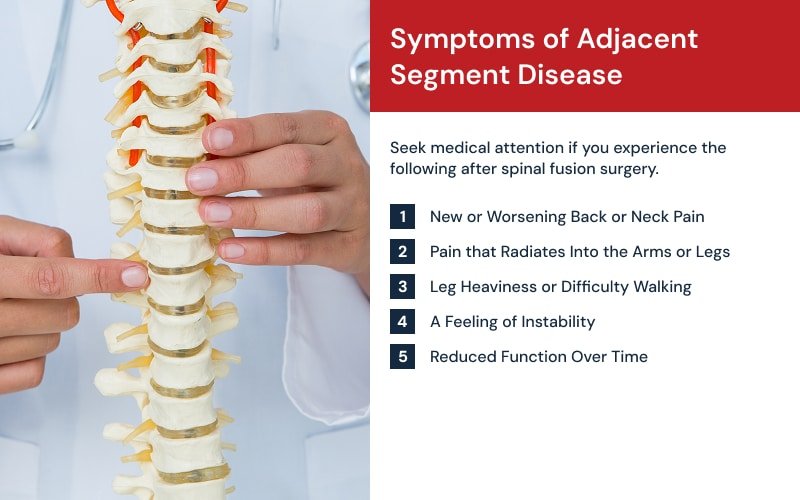
Adjacent segment disease often develops gradually. Some people notice mild symptoms at first, while others experience discomfort that feels similar to the pain they had before their original surgery. The symptoms typically vary depending on the part of the spine affected and whether nearby nerves have become compressed.
1. New or Worsening Back or Neck Pain
One of the most common symptoms is pain that develops near the fused segment. This may present as a dull ache, stiffness, or a deeper mechanical discomfort that worsens with certain movements. The pain may be located just above or below the fused level and can become more noticeable during prolonged standing, walking, or physical activity.
2. Pain that Radiates Into the Arms or Legs
If degeneration at the adjacent level begins to compress a nerve, the symptoms may extend beyond the spine itself. Patients may develop tingling, numbness, burning sensations, shooting pain, or weakness along the path of the affected nerve.
The location of these symptoms often depends on which part of the spine is involved. For example
- Cervical spine (neck): Symptoms radiating into the shoulders, arms, or hands
- Lumbar spine (lower back): Symptoms radiating into the buttocks, thighs, calves, or feet.
3. Leg Heaviness or Difficulty Walking
In cases where the disease occurs in the lumbar spine, this may lead to spinal stenosis, which is the narrowing of the spinal canal. This places pressure on the nerves travelling through the lower back, which can cause heaviness, cramping, or discomfort in the legs during walking or prolonged standing. Symptoms often improve when sitting down or bending forward.
4. A Feeling of Instability
In some cases, patients describe a feeling that their back is less stable than before. For example, they may feel sensations like weakness, discomfort, or “catching” during certain movements such as bending, twisting, or standing up from a seated position. However, these symptoms may not be due to actual spinal instability. Rather, they may be a sign that the adjacent spinal structures are no longer functioning as smoothly as they once did.
5. Reduced Function Over Time
As symptoms progress, everyday activities may become increasingly difficult. Patients may find themselves avoiding long walks, reducing physical activity, or struggling with tasks that require prolonged standing. In more severe cases, weakness, balance difficulties, or reduced mobility may begin to affect quality of life.
The symptoms of adjacent segment disease can appear within a relatively short period after surgery or may take many years to develop. The timing may vary from person to person and depends on multiple factors, including age, spinal alignment, and activity level. However, any progressive neurological symptoms, particularly worsening weakness or significant changes in walking ability, should be assessed promptly.
Is It Truly Adjacent Segment Disease?
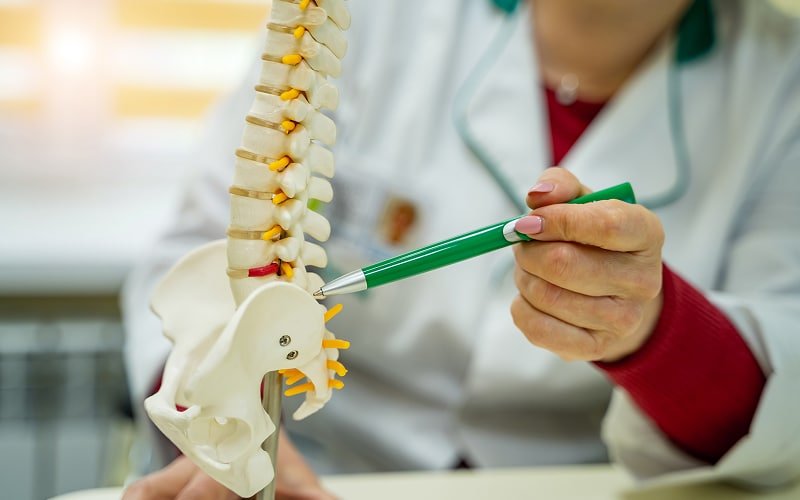
Complications that develop after spinal fusion may not always be caused by adjacent segment disease. Before making a diagnosis, specialists typically work through a series of questions to identify the source of your discomfort.
Step 1: Where Is the Pain Coming From?
First, they will need to understand your symptoms in detail. Your specialist will typically ask about:
- The exact location of the pain
- Whether symptoms occur above, below, or directly within the fused area
- Activities that worsen or relieve symptoms
- Whether pain travels into the arms or legs
- The presence of numbness, tingling, or weakness
Pain patterns often provide valuable clues. For example, pain that follows a specific nerve distribution may suggest compression at an adjacent level rather than general post-surgical discomfort.
Step 2: Is It Pain From the Adjacent Level, or Something Else?
Not all pain after fusion originates from the adjacent segment. Several other conditions can produce similar symptoms. This may include:
Scar tissue affecting a nerve
Scar tissue may develop around nerve roots after surgery. In some cases, this tissue can irritate nearby nerves and produce symptoms similar to those caused by new nerve compression.
Hardware-related irritation
Although uncommon, surgical implants may occasionally contribute to local discomfort. Patients may notice tenderness over the surgical site or pain triggered by specific positions. This tends to produce localised pain rather than radiating nerve symptoms.
Changes not directly related to fusion
Other structures can become painful over time, including the facet joints, sacroiliac joints, muscles, and ligaments. These conditions may occur independently and are not necessarily caused by the previous fusion.
Step 3: Do the Scan Findings Match the Symptoms?
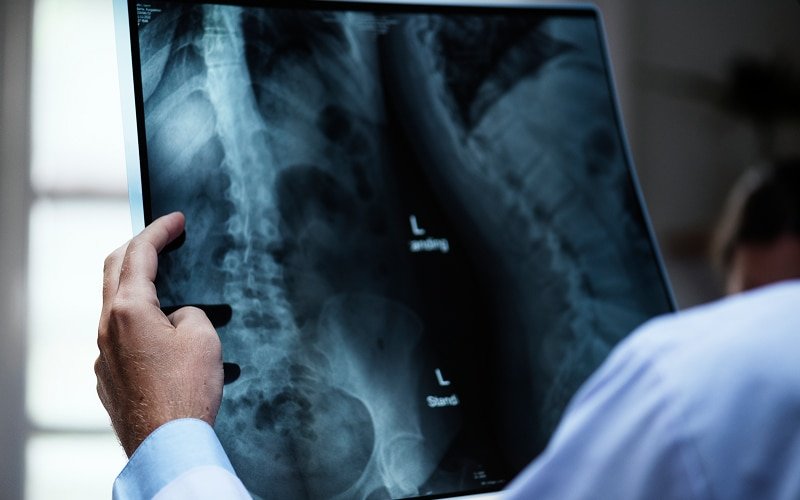
Imaging tests such as MRI scans, CT scans, and X-rays help doctors identify changes in the spine, but they are only one part of the assessment. It is common for people to have findings such as disc degeneration or disc bulges on a scan without experiencing any symptoms.
A specialist will look for changes at the levels next to the fusion, such as:
- New disc collapse or degeneration at the adjacent level
- Herniated or bulging discs
- Narrowing where nerves exit the spine (foraminal stenosis)
- Narrowing of the spinal canal (stenosis)
- Evidence of abnormal movement on dynamic flexion-extension X-rays
The goal is to determine whether the abnormalities seen on imaging correspond to the patient’s symptoms and examination findings.
Step 4: Can the Source of Pain be Confirmed?
Sometimes, symptoms and imaging findings do not point clearly to a single source of pain. In these situations, a specialist may recommend a targeted diagnostic injection.
The injection is placed around a specific structure that is suspected to be causing the symptoms, such as a nerve root or facet joint. If the patient’s pain improves significantly after the injection, it suggests that the treated area is likely contributing to the symptoms. This can help confirm the diagnosis and guide future treatment decisions, particularly when considering more invasive procedures.
How is Adjacent Segment Disease Treated?
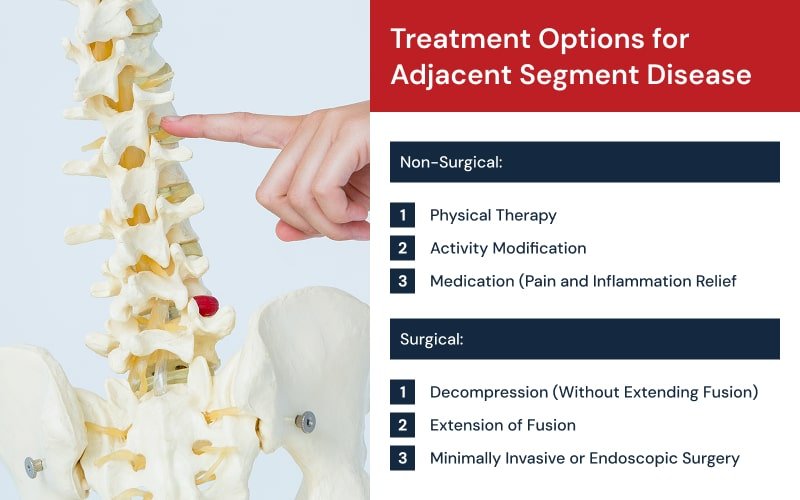
The most appropriate treatment for adjacent segment disease depends on several factors, including the severity of symptoms, the presence of nerve compression, spinal stability, and how much the condition is affecting daily life. While some patients may require surgery, non-surgical measures can also provide relief.
Non-Surgical Management
For patients with mild to moderate symptoms and no significant nerve-related problems, conservative treatment is often the first step. The goal is to manage symptoms, improve function, and reduce stress on the affected spinal level.
1. Physical Therapy
Physical therapy focuses on improving the way the spine moves and functions. Your doctor may prescribe exercises to strengthen the core and back muscles, improve flexibility, and address posture or movement habits that place unnecessary stress on the spine. Strengthening the supporting muscles can help take some of the load off the affected spinal segments and improve overall stability.
2. Activity Modification
Certain movements and activities can aggravate symptoms. Rather than avoiding activity altogether, doctors may encourage patients to identify specific triggers and make practical adjustments where possible. This may include using proper weight-lifting techniques, modifying exercise routines, or taking regular, timed breaks from sitting.
These adjustments can help reduce strain on the affected spinal level while allowing patients to remain active and maintain their daily routines.
3. Medication for Symptom Control
Medication may be prescribed to help manage pain, especially during symptom flare-ups. Depending on the type and severity of your pain, your doctor may prescribe anti-inflammatory medication and pain relievers. While medication does not address the underlying structural causes, it may help improve comfort and allow patients to participate more actively in rehabilitation.
Surgery for Adjacent Segment Disease
Revision spine surgery may be considered when your symptoms persist despite conservative treatment, neurological symptoms worsen, or imaging confirms structural changes that are unlikely to improve without intervention. The specific procedure depends on the underlying cause of the symptoms.
1. Targeted Decompression Without Extending Fusion
In selected patients, nerve compression may be the primary problem while the adjacent segment remains stable.
In these situations, decompression alone may be sufficient. The procedure removes the structures pressing on the nerve to relieve symptoms, without extending the previous fusion to the neighbouring level. This means the surgeon can address the nerve compression without permanently joining an additional segment of the spine, helping to preserve more natural movement.
2. Extension of Fusion to the Adjacent Level
If adjacent segments of the spine have become unstable, severely worn down, or structurally compromised, your surgeon may recommend extending the existing fusion to include this newly affected level.
This involves permanently joining an additional spinal segment to improve stability and reduce abnormal movement that may be contributing to pain or nerve compression. While this approach can help address both the source of instability and the compressed nerves, it also further affects and restricts spinal movement.
For this reason, careful assessment and surgical planning are important when determining whether extending a fusion is the most appropriate option.
3. Minimally Invasive or Endoscopic Revision Surgery
In suitable patients, adjacent segment disease may be treated using minimally invasive spinal surgery.
Rather than accessing the spine through a larger incision, surgeons use specialised instruments, such as an endoscope, and cameras to reach the affected area through smaller openings. This can be particularly beneficial in patients who have previously undergone spinal fusion, as it may allow surgeons to access the adjacent level while minimising disruption to the surrounding muscles and soft tissues.
With less tissue disturbed during surgery, some patients may experience less postoperative pain, a shorter hospital stay, and a quicker return to daily activities. However, not every case is suitable for a minimally invasive or endoscopic approach. The most appropriate technique depends on factors such as the location of the affected segment, spinal stability, and the complexity of the condition.
Frequently Asked Questions
1. How long does adjacent segment disease take to develop?
The disease can develop months or even years after fusion surgery. One study found that adjacent segment disease developed an average of 4.7 years after the initial fusion surgery. However, the timeline varies from person to person and can be influenced by factors such as age, spinal alignment, the number of fused levels, and the presence of pre-existing degeneration.
2. Can adjacent segment disease be prevented?
There is no guaranteed way to completely prevent adjacent segment changes, as spinal degeneration is part of natural ageing. However, maintaining good posture, core strength, healthy weight and spinal alignment may help reduce mechanical stress. Careful surgical planning and appropriate level selection during the initial fusion also play a role.
3. Can I continue exercising if I have adjacent segment disease?
In many cases, yes. Staying active can help maintain strength, flexibility, and overall spinal function. However, certain activities may aggravate symptoms, particularly those involving repetitive bending, twisting, or heavy lifting. A spine specialist can advise on which exercises are appropriate and whether any modifications are needed based on your symptoms and condition.
Conclusion
No two cases of adjacent segment disease are exactly alike. Factors such as the location of the affected level, the presence of nerve compression, spinal stability, and a patient’s lifestyle goals all influence the most appropriate treatment approach. This is why treatment planning often requires a careful balance between relieving symptoms, preserving function, and maintaining long-term spinal health.
At Achieve Spine And Orthopaedic Centre, we focus on preserving motion and reducing recovery times where appropriate. With options for minimally invasive and endoscopic spine surgery, we aim to address the source of your symptoms while minimising disruption to surrounding muscles and soft tissues. If you are experiencing persistent discomfort after spinal fusion surgery, contact us to arrange a consultation and discuss the treatment options available.
References:
- Loggia, G., Farshad, M., Jokeit, M., Widmer, J., Dossi, S., & Burkhard, M. D. (2025). Impact of spinal alignment on adjacent segment disease and degeneration after short-segment lumbosacral fusion. The Spine Journal, 25(11), 2461–2474. https://doi.org/10.1016/j.spinee.2025.03.032
- Kim, B. Y., Concannon, T. A., Barboza, L. C., & Khan, T. W. (2021). The Role of Diagnostic Injections in Spinal Disorders: A Narrative Review. Diagnostics (Basel, Switzerland), 11(12), 2311. https://doi.org/10.3390/diagnostics11122311
- Okuda, S., Yamashita, T., Matsumoto, T., Nagamoto, Y., Sugiura, T., Takahashi, Y., Maeno, T., & Iwasaki, M. (2018). Adjacent Segment Disease After Posterior Lumbar Interbody Fusion: A Case Series of 1000 Patients. Global spine journal, 8(7), 722–727. https://doi.org/10.1177/2192568218766488

Wu Pang Hung
ABOUT AUTHOR
Dr. Wu Pang Hung is an experienced orthopaedic and spine surgeon in Singapore, specialising in both uniportal and biportal endoscopic spine procedures for complex cervical, thoracic, and lumbar spinal conditions. With over 10 years in the field, he is actively involved in numerous spine societies and contributes to several international journals and textbooks. Dr. Wu has also received specialised training in spine surgery across Canada, South Korea, Japan, and Germany.
Contact Us
WHATSAPP US @+65 9746 6178
CALL US @+65 9746 6178
MAKE AN APPOINTMENT