

Introduction
Arthritis is usually associated with the knees, hips, or hands, but the joints of the thoracic spine can also undergo arthritic change. When arthritis in the upper back becomes symptomatic, it may cause a deep ache, stiffness, or discomfort with twisting and arching backwards. These symptoms can resemble muscle strain, disc-related pain, or other thoracic spine problems, so pain location alone does not confirm the cause. In this article, we explain why thoracic spinal joints can become arthritic, what symptoms may occur and how treatment is usually approached.
Key Takeaways
- Arthritic changes in the thoracic spine can affect the facet joints and may cause pain, stiffness, and reduced mobility, although scan findings do not always match symptom severity.
- Management usually begins with activity adjustments, exercise or physical therapy, and symptom control, rather than surgery.
- Medical assessment becomes more important when pain persists, limits daily activities, or occurs with neurological symptoms or other warning signs.
What Causes Arthritis in the Upper Back?
The thoracic spine contains paired facet joints at the back of each motion segment. These small synovial joints help guide spinal movement and, like other joints, can change over time.
Age-Related Degeneration
Age is an important contributor to spinal osteoarthritis, but the process is more complex than simple “wear and tear”. Current understanding recognises changes across the whole spinal motion segment, including the disc, paired facet joints, bone, and low-grade inflammatory processes1.
As discs gradually lose height and hydration, forces may be redistributed across a spinal segment. More load can then reach the facet joints, contributing to facet joint arthritis and changes such as cartilage loss, joint-space narrowing, bone thickening, and osteophyte formation.
Degenerative findings can also appear on scans in people who have few or no symptoms. Therefore, interpret imaging alongside symptoms and examination findings when upper-back arthritis is suspected.
Mechanical Stress and Previous Injury
Repeated mechanical loading may contribute to degeneration, particularly alongside other risk factors. Previous trauma can alter how a spinal segment moves or distributes load, while some occupational or recreational activities may repeatedly stress the same areas.
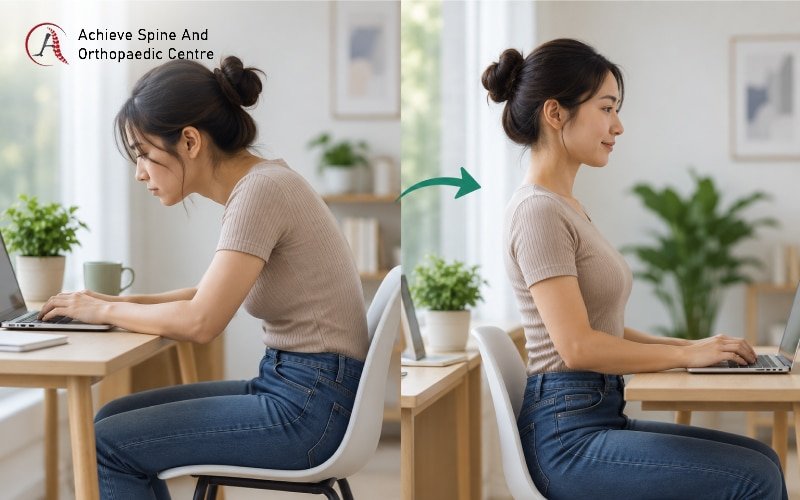
Posture also needs perspective. Slouching for a few hours does not suddenly produce arthritis, but prolonged uncomfortable or poorly supported positions can aggravate existing joint or muscle symptoms. For someone with spinal joint inflammation, changing positions regularly may be more useful than trying to hold one “perfect” posture all day.
Other Contributing Factors
Genetic susceptibility, body weight, metabolic factors, and inflammatory disease can influence joint health. Inflammatory arthritis is different from degenerative joint disease and may require a different medical approach. If symptoms suggest an inflammatory condition, further investigation may be needed instead of treating the problem as ordinary age-related degeneration.
Symptoms of Upper Back Arthritis
Symptoms vary, and thoracic spine pain has many possible causes. Arthritis in the upper back therefore cannot be identified reliably from one symptom alone.
Persistent Upper Back Pain
Facet-related discomfort is often described as a localised or deep ache around the upper or middle back and may be felt around the shoulder blades. A doctor assessing spine pain may ask when symptoms began, which movements reproduce them, and whether there was an injury. The assessment may also include movement testing and a neurological screen, with imaging used when indicated to help distinguish facet joint pain from muscle, disc, rib, nerve, or other thoracic causes.
Stiffness and Reduced Mobility
Stiffness may be more noticeable after rest or inactivity and may ease somewhat once you start moving. Rotation through the upper body can also feel restricted. Because the thoracic spine works with the ribs, shoulders, and surrounding muscles, reduced movement in one area may change how other areas compensate.
Pain That Worsens With Movement
Pain from an irritated facet joint may increase with movements that load the posterior joints, particularly extension or rotation. Twisting to reach behind you, arching the upper back, or repeated overhead activity may therefore be uncomfortable. Similar pain can also come from muscles, ribs, or discs, so examination matters before attributing it to arthritis.
Seek medical assessment more promptly if upper-back pain follows significant trauma, is accompanied by fever or unexplained weight loss, or occurs with progressive weakness, numbness, balance problems, or changes in bladder or bowel control.
How to Manage Arthritis in the Upper Back
Treatment should reflect symptoms, examination findings, and the underlying cause, not a scan’s appearance alone. Many people manage thoracic arthritis without surgery.
Lifestyle and Posture Adjustments
A useful starting point is to reduce activities that repeatedly aggravate the painful area while continuing tolerable movement. This might involve adjusting workstation height, changing sitting positions, taking movement breaks, or temporarily modifying lifting and exercise.
The aim is not to keep the spine rigid. Regular movement can help maintain mobility and reduce stiffness after long periods of inactivity. Sleep, general activity, and gradual conditioning may also influence how manageable persistent spinal pain feels.
Physical Therapy and Targeted Exercises
A physical therapy programme may include thoracic mobility work, upper back and trunk strengthening, and exercises for surrounding shoulder muscles. The programme should match your movement tolerance and health conditions rather than rely on a single generic routine.
If discomfort has led to prolonged activity avoidance, progression may need to be gradual. Where disc degeneration coexists with arthritic change, treatment for degenerative disc changes may also involve exercise, activity modification, medication, or other options depending on the actual pain source.
Medical Treatment for Persistent Pain
Medication may sometimes reduce symptoms, but suitability depends on your medical history and other medicines. If pain persists despite conservative care, reassessment can help determine whether the facet joints remain the likely source or whether another thoracic structure better explains the symptoms.
Surgery is not a routine treatment for thoracic arthritis. If degenerative or arthritic changes cause significant nerve or spinal cord compression, surgery may be considered when symptoms remain substantial despite appropriate non-surgical care.
In selected cases, spinal decompression surgery in Singapore may use a minimally invasive or endoscopic approach. Smaller access corridors can reduce disruption to surrounding muscles and soft tissues and may support a faster recovery and return to activity. Where appropriate, the goal is to relieve compression while preserving normal tissue and motion. Suitability depends on the affected level, anatomy, and cause of compression2.
Conclusion
At Achieve Spine & Orthopaedic Centre, we assess upper-back symptoms by considering your history, movement, neurological findings, and imaging where appropriate. This helps us distinguish possible facet-related pain from disc-related, muscular, nerve-related, or other thoracic spine causes before discussing suitable treatment options. If persistent upper-back pain or stiffness is affecting your daily activities, contact us to arrange an assessment.
References:
1. Margetis, K., Roberts, C. C., & Escobar, E. (2026). Spinal osteoarthritis. In StatPearls. StatPearls Publishing. https://www.ncbi.nlm.nih.gov/books/NBK553190/
2. Inzerillo, S., Ikwuegbuenyi, C. A., Gurav, E., Willett, N., Hamad, M., Hussain, I., Hernández-Hernández, A., Elsayed, G., Kashlan, O., & Härtl, R. (2026). Complications in thoracic minimally invasive spine surgery (2013–2024): A systematic review. Journal of Clinical Medicine, 15(1), 363. https://doi.org/10.3390/jcm15010363.

Wu Pang Hung
ABOUT AUTHOR
Dr. Wu Pang Hung is an experienced orthopaedic and spine surgeon in Singapore, specialising in both uniportal and biportal endoscopic spine procedures for complex cervical, thoracic, and lumbar spinal conditions. With over 10 years in the field, he is actively involved in numerous spine societies and contributes to several international journals and textbooks. Dr. Wu has also received specialised training in spine surgery across Canada, South Korea, Japan, and Germany.
Contact Us
WHATSAPP US @+65 9746 6178
CALL US @+65 9746 6178
MAKE AN APPOINTMENT